Friday, January 31, 2014

Unit 4: A Wrap Up


In this unit, I learned about a variety of concepts involving rotation. For starters, we learned about tangential and rotational speed. Tangential velocity is the linear speed of something moving along a circular path. Rotational velocity involves the number of rotations an object makes per minute.
The farther from the center, the more an object’s tangential speed increases. This is because there is more mass farther away from the axis of rotation so the object rotates slower- but this has to do with rotational inertia, which I will explain in a moment.
The difference between rotational and tangential speed is that tangential speed increases the farther away from the center the object is, but rotational speed remains the same no matter where the object is. For example, if one person is close to the inside of a merry-go-round, and their friend is riding a horse along the outside, the friend on the outside will have a faster tangential velocity but they will be moving at the same rotational speed. Additionally, if two objects are the same size, they have the same rotational speed. When two objects are different sizes, it is possible for them to have the same rotational speed but different tangential speeds, like the gears shown below:
Although the picture shows circles, imagine that they are gears that interlock. Because they are connected, a point along the edge of the larger gear will cover the same distance as a point on the edge of the smaller gear in an amount of time, meaning that they have the same tangential velocity. However, the smaller gear will be able to rotate once in a shorter amount of time than the larger gear. In fact, these gears share a 1:3 ratio; meaning that the rotational velocity of the smaller gear is faster than that of the larger gear and the smaller one will rotate completely three times in the time it takes the larger gear to rotate once.

Conversely, objects can also have the same rotational velocity and different tangential velocities. Just like on the merry-go-round, this applies to train wheels. They are tapered so that one side of the wheel is wider than the other and two wheels of this shape are connected. Since the sides are connected, they have the same rotational velocity. The wider part of the wheel has a higher tangential velocity and moves faster because it is farther away from the center than the smaller sides of the wheels. This higher tangential velocity causes the wider part of the wheel to curve inward so that the rails are off-center. When one side of the wheel curves, this causes the other side to curve as well and the wheel self corrects. This is why trains sway on the tracks.


Another related concept is that of rotational inertia. This is the property of an object to resist changes in spin (similar to linear inertia which is the property of an object to resist changes in motion). Rotational inertia depends where the mass is located, or the distribution of mass. As I said before, the farther away the mass is from the axis of rotation, the harder it is for an object to spin- aka, the more rotational inertia it has. If the mass is close to the center/axis of rotation, the object has little rotational inertia. When a runner is trying to go faster, they bend their legs. This brings their leg closer to their hip, which is the axis of rotation. Bringing their leg closer brings the mass closer, so the leg/hip system has less rotational inertia and it is easier to rotate/run. The less rotational inertia and object has, the faster its rotational velocity. This allows the runner to go faster. This concept also applies to ice skaters when they do their big finishes with crazy spins.
When an ice skater has her arms spread out and her legs are wide, her mass is distributed farther from her body (axis of rotation) so she has more rotational inertia and she has a low rotational velocity- she is spinning slowly. Then she brings her arms and legs in to her body, drawing the mass in closer to the axis of rotation and decreasing the rotational inertia, allowing her to spin faster. This brings us to the concept of angular, or rotational, momentum. Angular momentum = rotational inertia x rotational velocity. Just like the conservation of linear momentum, there is conservation of angular momentum. When there is a change in an object’s spin, the momentum is the same before and after. So if the ice skater has a high rotational inertia and a low rotational velocity before, and she has a low rotational inertia after, she must also have a high rotational velocity after to equalize the equation and make the momentum before and after her change in spin the same.
Angular Momentum before = Angular Momentum after
Rotational inertia x rotational velocity = rotational inertia x rotational velocity


So by this point, we know a lot about rotation and how it affects an object’s movement. But what causes rotation?
Torque, ladies and gentlemen, causes rotation. A torque is a force exerted over the distance from the axis of rotation. This distance is called a lever arm.
Torque = Force x Lever Arm
There are three ways to increase torque, and therefore increase the rotation of said object:
11)   Increase the force on the object
22)   Increase the lever arm
33)   Increase both the force and the lever arm
The Forces on both sides of the rod being balanced in the picture above are equal. Their lever arms are also equal. This means that they have equivalent forces on both sides of the rod so it is balanced. If one side had a greater torque than the other, this would cause a rotation and the rod would no longer be balanced. Also, if one side had a greater force than the other side but the other side had an equally greater lever arm, the forces would be equal.
Torque = Torque
Force x lever arm = Force x lever arm
(Just like the conservation of momentum)
As a side note, the force must be perpendicularly applied to the lever arm. Torque is measured in units of Newton meters (Nm).

One thing you will notice in the picture above that I have not yet talked about, is the center of gravity. The center of gravity is essentially the same as an object’s center of mass, which is the average position of all the object’s mass. When gravity acts on this exact point, it becomes the object’s center of gravity. This is actually what keeps us from falling over. As long as our center of gravity is above our base of support, there is no lever arm and without a lever arm, no torque can be generated, meaning there is no rotation and we don’t fall over.
In sports, it is easy to be knocked over. But if you change either your center of gravity or your base of support, it is harder to be knocked over. Bending your knees lowers your center of gravity so it is harder to push it out from above the base of support as has been done to the box in the picture above. If you stand with your feet planted at least shoulder width apart (larger than your natural stance) this widens your base of support, which also makes it harder to displace the center of gravity outside the base of support. These two adjustments make it much harder to knock you over.


Lastly, we learned about centripetal and centrifugal forces. Centripetal force is a center seeking force. It is the force acting on you, pulling you into a curve. When an object moves, its velocity is always straight. Combined with a centripetal force equal to the velocity, the object can follow a curved path. This is why the moon orbits the Earth (the centripetal force being the pull of Earth’s gravity).
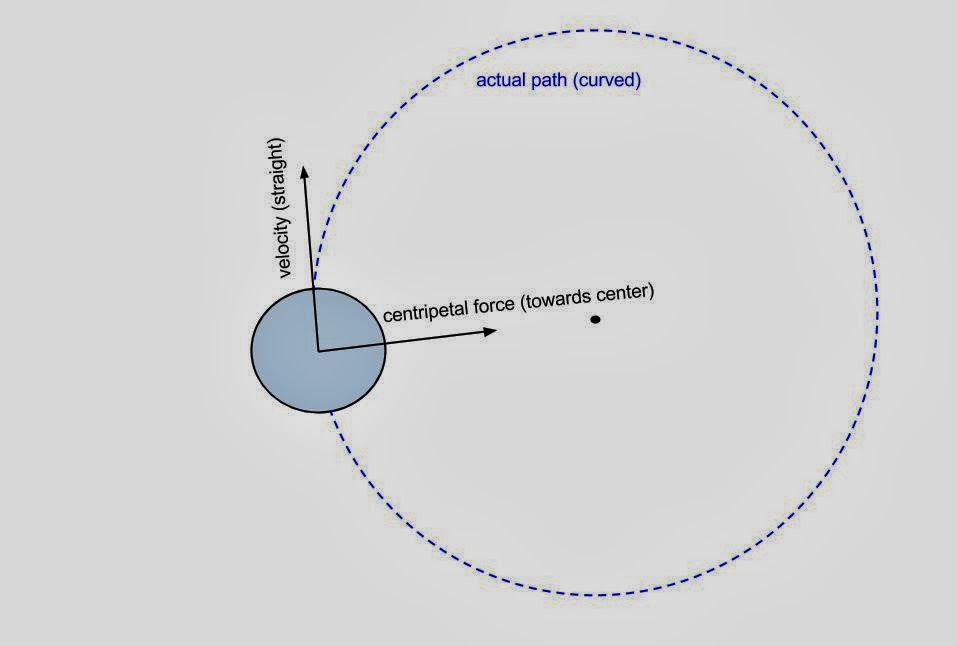
Centrifugal force is a “center fleeing force,” but it is a fictitious force. It is only the feeling of your body responding to the centripetal force pulling you inward. For example, when you are riding in a car, you are moving forward. According to Newton’s 1st Law of Motion, when an object is in motion, it tends to stay in motion unless acted upon by an outside force. (This is where your inertia comes in! Linear, not rotational). When car you are in turns, your body continues to move forward because 1) velocity is always straight and 2) you have inertia, which causes you to resist changes in motion. Only when the car door pushes into you and forces you to turn with it do you turn. This is the centripetal force acting on you. The feeling of your body not wanting to turn is what we refer to as centrifugal force but it is not actually a force. With a group of classmates, I made a podcast that explains even more clearly the concepts of centripetal and centrifugal forces:


The most difficult thing about what we have studied in this unit has been grasping the visualizations of certain concepts. I am primarily a visual learner so this was a little challenging at times. For example, I have seen ice skaters and we watched videos of ice skaters spinning and getting faster, but I do not know what a train wheel actually looks like aside from the strange diagrams and drawings we looked at in class. Sure, I’ve seen a train wheel before, but not from the angle we were considering. This made the concept of train wheels and their tangential velocities hard to understand at first. I overcame this by just accepting what Mrs. Lawrence was teaching me and applying the concepts to the picture I was provided. Eventually the idea cleared up and I grasped the concept. All it really took was for me to open up to a new perspective.

I think my effort towards homework and quizzes improved noticeably this unit. I studied for nearly all of the small quizzes we took and I spent a lot of time writing out my homework and forming really thorough answers which paid off as it aided in my understanding of the lessons. This boosted my confidence in class when we were discussing some harder problems. Also it developed my communication; I feel pretty good about explaining the information in this unit because I spent so much time explaining it to myself and writing out these explanations in a way that I can go back and read in a few months and still get it. I also think that my group for this podcast collaborated more efficiently and easily than my groups in the past. I am really glad that I will be working with the same group for a little while because I think we work well together and I would say this is one of the more articulate podcasts that I have been a part of making.

My goal for the next unit is to spend more time on my podcast and do something a little more unique. I also am going to have a more positive attitude in class!

I liked this unit a lot, even though I did not immediately “get” everything we talked about. I love sports and just about everything in this unit can be applied to my main sports- I run, so now I understand why bending my legs more will help with sprinting. In playing soccer, I will definitely widen my stance and bend my knees more to keep from being knocked down- which seems to happen to me a lot. Also I have been catching even more physics mistakes in song lyrics since this unit. Yay for physics!

Tuesday, January 21, 2014

Balancing Act

As we are learning about torque and center of gravity, we are also conducting a lab. Our goal is to find the mass of a  meter stick using only the stick itself and a 100 gram lead weight. We are not allowed to use a scale to find the mass of the meter stick. 

Step 1:

When an object is balanced, the torques on either side of its center of gravity are equal. This means that, collectively, the force and lever arm on either side of the center of gravity are the same. However, one side of the stick could have a long lever arm and little force while the other side could have a lot of force with a short lever arm. As long as the counter-clockwise torque on one side equals the clockwise torque on the other side the object will be balanced because neither rotation overpowers the other so the object will not rotate either way.


When the meter stick is placed on a table with some of it hanging off the edge, the center of gravity (for my group's stick) was at the 50.25 centimeter mark on the stick. This is the point that sits on the very edge of the table where part of the stick can hang off without causing any rotation. 
When a mass is placed on the edge of the meter stick, the center of gravity is shifted to the 29.5 centimeter mark. The distance from the stick's actual center of gravity to the edge of the table, where the new center of gravity is, is now its lever arm, instead of being from the center of gravity to the end of that side of the stick. This means the lever arm is much smaller and that the force on the stick is at the end of this lever arm, not at the end of the stick.

Step 2:

We started with what we already knew about torque and balanced objects. When an object is balanced, the torques on either side of its center of gravity are equal. Therefore, it was essential that:
counter clockwise torque = clockwise torque
Since torque = force x lever arm...
force x lever arm = force x lever arm
Not only were these equations going to be important for us to use, so was the equation for weight, since the whole purpose of the lab was to find the mass of the meter stick. It is:
weight = mass x gravity (w=mg)
We kept in mind the units of all the variables we would be working with.
Weight: Newtons (also in kilogram meters per second squared: kg m/s^2)
Mass: grams and kilograms (100 grams equals 0.1 kilogram)
Gravity: 9.8 meters per second squared (m/s^2)
Force: Newtons
Lever Arm: centimeters (but usually we work in meters for lever arm)
Torque: Newton centimeters (N cm; usually it would be Newton meters)
We chose to use our knowledge of torque for this experiment and our calculations because we knew that force and weight are both in Newtons and are equal. So if we could figure out the torque of one side, we would know both the force on that side (because we could just measure the lever arm and find the force through simple math) and the torque of the other side of the center of gravity because the two torques would be equal). Using this knowledge, we could find the mass through the equation for weight. In order to complete these processes, we took measurements. We found the length of all the lever arms and the point where the center of gravity was. We also found the mass of the weight placed on the meter stick, both in grams and kilograms.

Measurements:

Center of gravity = 50.25 cm mark
Center of gravity with the weight o the meter stick = 29.5 cm mark
Mass of weight = 100 grams (0.1 kilograms)
Lever arm to the left of new center of gravity = 29.5 cm (as shown in picture above)
Lever arm to the right of new center of gravity = 20.75 cm (as shown in picture above)

Step 3:

After we had all of our preliminary measurements taken and our plan of action was established, we began calculating. First, we found the force on the left side of the center of gravity with the weight. Here are our calculations:
w=mg
  = 0.1kg (9.8 m/s^2)
  =0.98 N = Force
Then we found the torque on this portion of the ruler...
torque = force x lever arm
            = (0.98 N)(29.5 cm)
            = 28.91 N cm
Now it was time to find the torque of the other side of the center of gravity...
counter-clockwise torque = clockwise torque
                      [ 28.91 N cm = 28.91 N cm]
               force x lever arm = force x lever arm
              (0.98 N)(29.5 cm) = F (20.75 cm)
                        28.91 N cm = F (20.75 cm)
                                1.39 N = F
Since Force = weight...
1.39 N = weight
weight = mass x gravity
1.39 N = mass (9.8 m/s^2)
0.1418 kg = mass (b/c N also equal kg m/s^2 so when divided, the units cancelled out to kg)
141.8 g = mass
This was our calculated mass (141.8 grams) which we checked on the scale after the experiment concluded. The actual mass of the meter stick was 142.9 grams, so we were very close (only 1.1 grams off).

Saturday, January 18, 2014

Torque and Center of Mass


A torque causes rotation. Torque = force x lever arm (the distance of the force from the axis of rotation). The example shown in the video demonstrates torque well as it shows the two sides of the ruler have the same lever arm and their torques are equal so the ruler is balanced on his finger. When I say the torques are "equal," I mean that the counter-clockwise torque on the left side of the ruler and the clockwise torque on the right side of the ruler are equal to each other so they balance each other out. This video, although it does not go into detail, also shows the center of mass. The center of mass is the average position of all the mass of an object. When gravity acts on this point, it is the object's center of gravity. The object's center of gravity is right where the man is supporting the ruler with his finger, which is another reason why it is balanced. 
I think this video is a good resource because it explains torque very clearly and in a lot of detail. The end of the video is actually more advanced than the material we covered in class; we did not learn about the equations he uses. But despite this, I think the rest of the video is clear and helpful. The demonstration shows torque really well, as well as center of gravity even though it does not explicitly go into detail about center of gravity.

Sunday, January 12, 2014

Rotational/Angular Momentum


Having already learned about momentum and the conservation of momentum, my class recently learned about angular, or rotational, momentum. To understand rotational momentum, you must first know about rotational inertia. Rotational inertia is the property of an object to resist changes in spin (rotation). The more mass an object has, the greater its rotational inertia is. This also involves the distribution of the mass. When the mass of an object is far away from the axis of rotation, the rotational inertia is greater. When the girl in the video is starting to spin, she keeps her arms extended. This causes her mass to be spread out from her body, where her axis of rotation is, so she spins slowly at first. When she pulls her arms and legs into her body, this changes the distribution of mass so that it is closer to the axis of rotation. She then has a smaller rotational inertia and spins very quickly.

But wait, there's more...

Just as linear momentum is conserved, there is conservation of rotational momentum as well. The total rotational momentum of an object before the change in spin must be equal to the total rotational momentum of the object after the change in spin. Rotational momentum is equal to rotational inertia  x rotational velocity. In the video, we could see how the girl's rotational inertia changed (which I explained) and how it directly affected her velocity. Before the change in her spin, she had a large amount of rotational inertia and a subsequently small rotational velocity. After the change in spin, her rotational inertia was much smaller, and in accordance with conservation of rotational momentum, her rotational velocity increased so that the total momentum was the same before and after the change in spin.

I think this video clearly shows the change. The demonstration would be perfect if there were arrows showing her inertia and such, but I think this is a great rotational momentum resource when coupled with an explanation.

Tuesday, December 10, 2013

Unit 3 Summary


In this unit I learned about Newton’s 3rd Law and all the things it can be applied to. Newton’s 3rd Law states that: every action has an equal and opposite reaction. For example:
If an apple is at rest on a table, the apple pushes down on the table, and the table pushes up on the apple.


This concept goes a long way in explaining why various things work. If you have ever gone on a horse-drawn carriage ride, I am sure you remember it being a fun, and almost magically unique experience. Well, it is nearly magical how perfectly Newton’s 3rd Law fits into a horse and buggy system. Without this law of physics, there would be no carriage rides. You may be wondering how this works…


The horse and buggy pull on each other with equal and opposite force- the horse pulling on the buggy alone does not cause the buggy to move. They both, however, exert force on the ground. The horse pushes on the ground with more force than the buggy so the ground pushes back on the horse with more force than it pushes on the buggy; thus the horse and buggy move in the horse’s direction.
This explanation applies to tug of war, and a plethora of other real life situations.

I also learned about adding vectors. Using the horizontal and vertical velocities of an object, you can find the actual velocity.


To predict accurately the direction of the actual velocity vector, you use dotted lines that are parallel to the other vectors and the arrow of the actual velocity should be drawn through the point where these intersect. This can be used to find the direction of a boat when the velocity of a current and the velocity of a paddle are taken into account. It can also be used to explain why a box slides down a ramp.


The force of the box’s weight must be drawn straight down as that is how gravity pulls it, and the support force of the ramp is drawn perpendicular to the ramp itself. When the dotted lines are drawn parallel from these vectors, a parallel line should be sketched out to show the net force on the box, showing that the net force pulls the box down the ramp.
A similar concept is applied to tension. If a ball was hung by two ropes, the force of the ball’s weight would be drawn as a vector pointing down, then an equal and opposite vector would be drawn upwards from the ball to show its net force. After drawing lines parallel to the ropes but which intersect at the tip of the net force vector, you can draw (from the ball to the point which these dotted lines intersect the ropes) arrows depicting the force of tension on each rope. The longer arrow shows which rope has a greater tension.

Thus far, I have talked a lot about force on the Earth. However, force exists outside of our planet as well. Before considering this, it is important to know that…
 Force is directly proportional to mass: F ~ m
 Force is inversely proportional to distance squared: F ~ 1/d^2
With this in mind, we learned that there is a universal gravitational force. The formula for this is:
F = G(m1xm2)/d^2
G is equal to (6.67 x 10)^-11. This equation helps us to find the force of gravity between two object by using their masses (m1 and m2) and dividing them by the distance between the objects squared. It is very important to square the distance.
Believe it or not, the tides of the ocean are actually connected to this universal gravitational force. The Earth is so large that the distance from one end of the ocean to the opposite is great enough for each of these points to have a significant difference in their distance from the moon. This difference in distance causes the tides. The moon’s gravity pulls the water ever so slightly towards it, giving the Earth’s water an oblong shape in reality. Due to this oblong shape, when it is high tide on the end of the Earth closest to the moon, it is high tide on the opposite end farthest from the moon. Likewise, it will be low tide at the top and bottom of the Earth at this time.


If the moon pulls on point A with 25 N of force, pulls on B with 5N of force, and pulls on the center of the Earth with 15N of force, how does all this tide business work? Using simple math, we can see that 25-15= 10 N with which side A is pulled to the Earth. 5-15= -10N with which side B is pulled to the moon. Like the forces addressed in Newton’s 3rd Law, these forces are equal and opposite. Therefore the sides are pulled with the same amount of force in opposite directions, causing the oblong shape and corresponding tides.
It takes 24 hours for the Earth to rotate once; the length of one day. There are 2 high tides and 2 low tides in every day- each tide occurs about 6 hours apart. They change as the world spins and different part of the world are closer to the moon. However, the moon moves as well. It takes the moon about a month to complete its orbit around the Earth. Each month, it is not in the exact same spot on the same days, which causes the tides to be a little different every time, just as they are a little bit different every day due to the imprecise and varying location of the moon from day to day. Since the tides change and the moon’s location changes, there are Spring and Neap tides at different times of the month. During Spring tide, the moon is either new or full, being in a line with the Earth and the sun. At this time, the high tides are higher than normal and the low tides are lower than normal. Low tide during a Spring tide is a great time to go clamming. At Neap tide, the moon is neither between the Earth and the sun nor on the other side of the planet in a line from the sun. It is on either side of the Earth; “on top” or “beneath” the planet. During Neap tides, the high tide is lower than normal and the low tide is higher than normal.


You can use the universal gravitational force formula to talk about tides, but you can also use it to find the force between planets. You can find the pull between the Earth and the sun, and the Earth and the moon, alike. The farther two objects are, the weaker the force is between them because of the relationship force and distance share. However, the sun does not have a weaker pull on the Earth than the moon does just because of their distances from the planet. The sun’s mass is so much greater than the moon’s that its force is greater nonetheless.

Next, I learned about momentum.
Momentum, or inertia in motion, is mass times velocity. (p=mv)
Change in momentum is simply the final momentum of an object minus its original momentum. (change in p = p final – p initial). It can also be written as change in p = mv final – mv initial.
Momentum is also equal to impulse. Impulse is force times a time interval (J= F x change in time)
All of this information may seem random when presented like this, but answering one big question can bring it all together: why do airbags keep us safe?

When a car crashes, it and you go from moving to not moving. The change in momentum here is the same no matter how you are stopped because your momentum is changed to zero since change in momentum = p final – p initial. Change in momentum is equal to impulse (change in p = J), so the impulse is also the same no matter how you are stopped. Since impulse equals force times change in time (J = F x change in t), when the time of the impulse is very long, the force is small, and vice versa. Thus, the airbag is soft and takes a long time o stop your movement, so the force is less. The smaller the force, the less you are injured. This is why airbags keep you safe.
This unit, my group made a podcast about momentum, impulse, and the relationship between the two. Here it is, hopefully it adds clarification to the concept:


According to Newton’s 3rd Law, in any collision, all forces have an equal and opposite force. So what about momentum? If ball A and ball B are headed towards each other and collide with equal and opposite forces, the collision could be noted as F(A) = -F(B). J = F x change in t, so F(A) x t = -F(B) x t, since they both experienced the force for the same amount of time. This equation can be rewritten as J(A) = -J(B), which can then be rewritten as change in p of A = - change in p of B (because J= change in p). Change in p (A) – change in p (B) = 0, since they were equal. Therefore, this system has no leftover or extra momentum. Momentum is conserved in systems, meaning there is no net change in momentum. Collisions like this can be examined using the equation  p total before = p total after. This is rewritten as M(a)V(a) + M(b)V(b) = M(a+b) x V(ab), which presents the equation in a form to which you can plug in numbers (the mass and velocities of two different objects). It is important to remember to make one of the velocities negative since the objects are moving in opposite directions before they collide. This equation is for objects that collide and then stick together. It can be reversed to apply to objects that detach in the interaction. If the objects do not stick together, the equation M(a)V(a) + M(b)V(b) = M(a)V(a) + M(b)V(b) can be used. This is the most basic form of p total before = p total after.
If an object bounces before it stops it undergoes two changes in momentum: when it stops and when it starts moving again. Thus the object has two impulses and therefore twice the force. Bouncing objects can be more dangerous.
What I have found difficult about what I have studied is separating the equations involving force from unit 2 and the equations involving force from unit 3. F = ma seems like it should be used but it is not relevant to this unit, so it has been a struggle to keep all the equations straight in my head in correspondence with the proper concepts.
I overcame this difficulty by reviewing the material and thinking more closely about what each concept was saying. This clarified the connection between the information and the equation for me.

I put in a little less effort to the class after Thanksgiving break; this is partially due to being sick and also because it is hard to transition back into school after a longer break in the midst of the end of the semester. I still continued to try and learn everything as thoroughly as possible, though. I feel very confident about this material as it makes sense to me and I understand the connections between the concepts introduced in this unit. My confidence in my knowledge of physics this unit helped me in all aspects of group collaboration these last few weeks. Whether discussing with a partner, working together on a lab, or completing a group project, I felt that I understood what was going on and was able to help others understand a bit better as well.
My goal for next unit is to find more creative ways to apply, present, and restate the information. This would help me to deeply learn the information in a versatile way. It would also make studying more fun.

I thought that the most interesting part of this unit was tides. I encounter them frequently enough, whenever I visit the beach they affect my entire time there. The connection between natural disasters and tides is especially interesting for me. Last fall, a very serious storm hit the northeast. Hurricane Sandy caused tons of destruction, injury, and chaos. One of the reasons it was such a bad storm was that it hut during Spring tide. Using the high high tides of Spring tide, Sandy caused more damage than it would have if it had hit during Neap or normal tides. This is just how nature works, though. The seemingly placid day-to-day workings of the world can just as easily turn events into drastic occurrences. I find this fascinating and I love that I now know the scientific reasoning behind this. It is also interesting to me how so much of our lives on Earth are affected by things outside of the planet itself.

Thursday, November 14, 2013

Tides

If you've ever been to the beach, I'm sure you've noticed how the water is high up on the shore at some parts of the day and it is very low at other points of the day. These are called high and low tides and they are caused by the moon and the sun and their position in relation to the Earth. Force is inversely proportional to distance squared, so the closer the moon is to a point on the Earth, the stronger the force between them will be. Likewise, with different points of water on the Earth, closer blobs of water to the moon will have a greater force on them than blobs of water on the other side of the Earth. This causes a bulge in the Earth's water; it has an ovular shape which allows for high tides to occur twice a day and low tides to occur twice a day across the globe, happening on opposite ends of the world at the same time. At different times of the year, the position of the moon in relation to the sun causes what are called spring tides (very high high-tides and very low low-tides) or neap tides (tides that are not as great in difference). Although I just gave a very brief summary of this relationship, the video below explains it quite well. Adam Hart-Davis uses food to demonstrate the moon's movement, the Earth's movement, and their effect on the Earth's tides. The visuals are very helpful. He could have included more detail about the process but I think this video gives a very good, simple explanation of tides.


Friday, November 1, 2013

Unit 2 Blog Summary

Part A: What I Learned

In this unit, I learned about Newton's 2nd Law, skydiving, free fall, throwing objects straight up, throwing objects up at an angle, and falling at an angle.

Newton's 2nd law states that  acceleration is directly proportional to force and inversely proportional to mass. We completed a lab to demonstrate this relationship. In conclusion, we found that as mass increases, acceleration will decrease, and if force increases, acceleration will increase in the same ratio.
You can write Newton's 2nd law using symbols...
a~F
a~ 1/m
or as an equation....
acceleration= net force/ mass
a= f(net)/m
An object's weight can be the force acting on the object. Weight is equal to the mass of an object times gravity (w=mg). If you know the mass of an object, you can find the weight or force on the object as gravity is always 9.8 m/s^2 (or 10m/s^2 for simple calculations).


Above is an illustration of the experiment we performed in the lab, including labels of acceleration and force. If you add mass into the picture, depending on where it is placed (on the hanging weight or the cart), either the force and acceleration will increase or they will both decrease.

When you go skydiving, air resistance plays a large role in your fall through the air. As you fall, your speed increases which in turn causes your air resistance to increase. Conversely, as your speed decreases, your air resistance decreases as well. Air resistance is affected by two things: speed, and surface area.
To start at the beginning, when you first step out of a plane, your velocity is at 0m/s, which is its lowest point during the entire fall. In this same moment, acceleration and net force are at their highest points of the fall. This is because at t=0 seconds, you have not yet begun moving at speed, thus you have no velocity. However, your acceleration will decrease as you build up more air resistance. Keep in mind, you are still falling faster and faster (velocity increases), but you are gaining speed at a decreasing rate (acceleration decreases). Your net force is at its highest point at t=0 seconds as well, not only because acceleration is directly proportional to force, but also because your air resistance builds up to equal your weight (aka the force of gravity which is pulling you down). When you have no air resistance, your weight is the only force acting on your body. As the opposing force of air resistance builds, the net force decreases until it reaches 0 Newtons (the point when air resistance = your f weight). This point when the two forces are equal is also the time in your fall when your velocity has reached the fastest it can possibly be- this is called terminal velocity. When you are in terminal velocity, f net = 0, velocity is constant, and acceleration = 0 m/s^2. It is a total reversal from t=0s because velocity is at its highest point in terminal velocity while acceleration and net force are at their lowest points.
So that covers the falling part. But to skydive, there comes a point when you need a parachute. If you fell without a parachute, hitting the ground at terminal velocity would be very painful! 
When you are falling and have reached terminal velocity, this is the point when you open your parachute. Immediately, your surface area is increased by the chute which increases the air resistance. The air resistance will be greater than the force of your weight, and since it is a force pulling you in the upward direction, your acceleration will be upward. This also causes the net force to be negative (it will no longer equal zero; at this point you are no longer in terminal velocity). As you slow down again and air resistance decreases, you reach a second terminal velocity. In this second terminal velocity, the acceleration and net force are both 0 again (equal to the first terminal velocity) and the air resistance will also be equal to the air resistance in the first terminal velocity as it has to equal the force of your weight for the net force to equal zero. The only thing that is different in the second terminal velocity is the velocity itself- it will still be constant but it will be much slower and safer in the second terminal velocity. From here you safely fall to the ground and the parachute has done its job.


When you fall straight down in free fall, another concept I learned in this unit, this means you are falling without any forces acting on you except for gravity. When you skydive, you are not in free fall. One cool thing about free fall is that mass does not matter. If you dropped a coin and a feather at the same time in a vacuum without air resistance, they would hit the bottom at the same time. This is because the only force acting on the objects is the force of gravity which is determined by an object's weight. You might be thinking, "I thought weight didn't matter?" You're wrong. Mass and weight are not the same thing. Weight is the mass of an object times gravity (w=mg). So, if you are finding the acceleration of an object, you use a=f net / mass; in free fall the f net = weight, so you can change the equation to say a= mg/m (acceleration is equal to mass times gravity divided by mass). Mass divided by itself equals one, so you can cancel out the m's. This leaves the equation as a=g (acceleration = gravity = 9.8m/s^2). So no matter what the mass of an object is, when an object is in free fall, it will always have the same acceleration. Here is a video to demonstrate:


You can use the distance equation (d=1/2gt^2) to find how far an object fell in free fall, substituting gravity for acceleration. You can also use V=gt to find how fast the object was moving when it hit the ground.

In free fall, you can (obviously) fall straight down, But you can also throw things up.


The picture above illustrates the path a ball will take. In reality, it would fall straight up and straight down, but for the sake of the drawing, the ball is shown a little displaced from this path. As the ball travels upward, it is propelled by the initial velocity with which it is thrown while gravity is acting on the ball in the opposite direction (down), causing it to slow down as it reaches the top of its path. Since the ball is in free fall, its acceleration is 10 m/s^2 during the entire time in the air. In this particular drawing, the ball is thrown up with an initial velocity of 30 m/s and its speed decreases by 10m/s each second it falls up. When the ball is at the top of its path, it has a velocity of 0m/s, but the acceleration of the ball will still be 10m/s^2. The ball then falls back toward the earth with an increasing velocity because velocity and gravity will be in the same direction again.
Just from this picture you can tell a lot about the situation. You know the balls initial velocity as well as its velocity at each point along its journey. You know the hang time of the ball (total time in the air) is 6 seconds. To find how high the ball got, you can use the distance formula. However, this formula does not account for velocity in the upward direction, so you can only plug in values from the ball's downward fall. For example:
d=(1/2)gt^2
=(1/2) (10) (3)^2
= 1/2 (90)
d= 45 m
To find how far the ball is from the ground at any given second of the fall, you would use the value found for the total distance as shown just above. Then you would count the number of seconds from the top of the path down to the second you are finding the distance for and use that number of seconds as the t value in the distance formula. Once a distance is found, subtract it from the total distance and you will have the distance from the ground at that second.

After I learned about falling in free fall and throwing things straight up in free fall, I learned about things falling at an angle in free fall and things being thrown up at an angle in free fall.

When an object falls at an angle, the vertical acceleration is constant (9.8m/s^2) and the horizontal velocity is constant (the initial velocity the object is thrown with is the velocity that the object will have in the horizontal direction for the entire fall). The vertical velocity continues to increase as the object falls, so the path it takes to the ground will be curved, or parabolic. To find the vertical distance you can use the same distance equation we are familiar with (d=(1/2)gt^2) and you can use v=gt to find the vertical velocity at a given second. You could use either of these equations to find the time of the object's fall. The time the object falls is the same vertically and horizontally; t is one variable that will remain the same in any equations for vertical or horizontal values, besides g. The time of the object's fall is determined by the vertical distance, or the height from which the object falls, which is why the distance formula is so useful and is only used for vertical values. To find the horizontal distance, velocity, or the time of the fall, we can use the equation v=d/t. Problems like this can be applied to an object being dropped from a plane or something being thrown off a cliff. 
It is also important to note that we use the vertical and horizontal velocities in our equations but we do not use the actual velocity of the object.
To find the actual velocity, we must know the vertical and horizontal velocities. When they are put together they make two sides of a box, through which a vector can be drawn diagonally to show the actual velocity of the object. In my physics class, we use either a 45 degree angle or a 3, 4, 5 triangle to find this value. The picture below is an example of how this is drawn. 

We use this triangle system to find the actual velocity for objects thrown up at an angle as well. An example of this would be hitting a home-run in a baseball game. To find the horizontal velocity and distance, we again use the v=d/t equation. For vertical distance and velocity in this situation, we use d=1/2gt^2 and v=gt because these objects are still in free fall. We treat the vertical equations that use g in the same way we treat them in problems of objects being thrown straight up. They can only be used with values from the fall downward. The vertical height determines the hang time of the ball so these equations are really useful. If the vertical velocity of the object was 1m/s and the horizontal velocity was 1m/s, the actual velocity would be 1.41 (the square root of 2) at a 45 degree angle. If both velocities were 10m/s, the actual velocity would be 14.1 m/s, and if they were 100m/s, the actual velocity would be 141 m/s.
When an object is thrown up at an angle, vertical velocity decreases on the way up- at its highest point, the object has a vertical velocity of 0m/s. The horizontal velocity, however, is constant. If an object is thrown with a horizontal velocity of 10 m/s, it will still move horizontally at 10m/s at the top of its path when the vertical velocity is 0m/s. Since it keeps moving horizontally, it has a curved path. On the fall back to the ground, the vertical velocity will increase at a constant acceleration of 10m/s^2.


What I found difficult about this unit was the concept of skydiving with air resistance. At first, I just couldn't wrap my mind around the fact that you speed up so you have more air resistance and then once you open your parachute your air resistance will increase, but as speed decreases the air resistance decreases as well. After some practice and looking at tons of examples and diagrams, it makes a lot more sense now. The transition to falling with air resistance to falling in free fall was weird at first because I kept expecting the objects to reach a terminal velocity but I think I have gotten the hang of that concept now, too. Again, I made the lightbulb click with visual examples and just really breaking the concept down.


This unit, I think I had more effort in class but I could have put more effort into my work outside of class. I need to make more time for myself to not only get my work done but also to do it well. I do think, conversely, that the time I put into doing problems paid off. I always took the time to finish the problems and think through them which really helped me to be active and present in class. When we went over concepts and certain problems in class, I had already spent a lot of time on them and mostly understood them in my own way, so it was nice to be able to use class as a solidifier. I am getting to be very confident in physics- I feel like I really understand what is going on and I do not question everything I do. This comes from making sure I understand everything on my own time and then moving on in class, adding onto the information learned.


My goals for the next unit are to spend more time on my work outside of class and to finish my podcast early. I have found that the podcast gets really stressful when I have other work to do and my group starts finding less and less time to meet. Hopefully we can utilize the preceding weekend more efficiently int he next unit. I also want to have a very deep, holistic knowledge of the next unit. I think it would be a very bad time to start only half processing the information and I want to keep working hard all semester (all year, too, but I am thinking short-term until winter break).


Part B: Connections

I can connect this unit to soccer. I play right back, and one of my best assets in the game is my ability to clear the ball. This is similar to throwing things up at an angle; I use my foot to lift the ball and kick it across the field, in an arc through the air. I had usually just focused on my form for this, making sure I transferred my body weight over the ball and followed through my kick with my leg and foot pointed. I would love to find the actual velocity necessary to get the ball where I want it to be and then use this to find the horizontal velocity I need to swing my leg with to get this kind of power. I know that I will now start trying to kick the ball at a 45 degree angle to see if that gives it a smoother arc at all. It would also be really interesting to feel what different velocities feel like. For example, how hard will I need to swing my leg to hit a ball at 30m/s? And how will this feel on my leg? Is this an easy velocity to reach or would I need to really kick with power?

My group this unit made a podcast about things falling at an angle.


I can't wait to learn the next unit! Yay physics!